Wi-Fi or Zigbee Smart Thermostats? Compared by Specs
As an Amazon Associate we earn from qualifying purchases. Links on this page are affiliate links.
When you compare a wi fi vs zigbee smart thermostat, you are choosing between two distinct connectivity methods. Both the Google Nest Thermostat and the SENCKIT Smart Radiator Thermostat Valve offer programmable schedules and smart home integration. The main difference lies in how they connect. The Nest uses Wi-Fi for direct internet access, while the SENCKIT valve relies on Zigbee, which requires a separate hub. This affects installation and compatibility with your existing home systems.
Key differences
| Aspect | Google Nest Smart Wi-Fi Thermostat | SENCKIT Smart Radiator Thermostat Valve |
|---|---|---|
| Connectivity | Wi-Fi | Zigbee (Hub Required) |
| System Compatibility | General HVAC systems | Radiator valves and floor heating |
| Smart Home Compatibility | Google Assistant, Matter | Alexa, Google Home, Tuya |
| Display Type | Not listed | LCD digital display |
| Wiring Requirement | Works without C wire in most homes | Not listed |
Which one should you choose?
Choose Google Nest Smart Wi-Fi Thermostat if
- You want a thermostat that connects directly to your Wi-Fi without needing extra hardware.
- You are upgrading a standard central heating or cooling system.
- You prefer integration with Matter-certified voice assistants.
Choose SENCKIT Smart Radiator Thermostat Valve if
- You control individual radiators or floor heating zones.
- You already have a Zigbee hub or want to use the Tuya ecosystem.
- You need a physical LCD display on the valve unit.
Verdict: Choose the Google Nest Thermostat if you are managing a central HVAC system and want a simple, hub-free installation. Pick the SENCKIT Smart Radiator Thermostat Valve if you need precise control over specific radiators or floor heating zones using a Zigbee network. Your choice depends entirely on your heating infrastructure and existing smart home setup.
Wi-Fi vs Zigbee Thermostat Specs
Connectivity method
The Google Nest Thermostat connects directly via Wi-Fi, allowing you to control it without additional hardware. You just need a Wi-Fi internet connection and the Google Home app. In contrast, the SENCKIT Smart Radiator Thermostat Valve uses Zigbee connectivity. This protocol requires a separate Zigbee hub to function, which is sold separately. While Wi-Fi offers a simpler setup for central thermostats, Zigbee is common for distributed valve systems. You must ensure you have the required hub for the SENCKIT device to integrate with your network.
Smart home compatibility
Both devices support major voice assistants, but their ecosystems differ. The Google Nest Thermostat is compatible with Google Assistant and all Matter-certified voice assistants. This gives you broad flexibility for future-proofing your smart home. The SENCKIT valve works with Alexa and Google Home via the Tuya or Smart Life app. It also supports Tuya as a platform. If you already use Matter-enabled devices, the Nest offers a more unified experience. If you rely on Tuya-based hubs, the SENCKIT valve integrates seamlessly with that specific ecosystem.
System compatibility
These products target different heating infrastructure. The Google Nest Thermostat is designed for standard home HVAC systems. It works with most systems and can operate without a C wire in many cases, though some specific setups like heat pumps or zone controls may require one. The SENCKIT valve is a thermostatic radiator valve intended for floor heating systems and radiators. It controls the opening and closing of pipes. You cannot use the SENCKIT valve for central forced air systems. Choose based on whether you have a central HVAC unit or individual radiator/floor heating zones.
Display type
The physical interface differs significantly between the two. The Google Nest Thermostat features a clean, minimalist design with no visible display in the provided specifications. It relies on the Google Home app for all adjustments and monitoring. The SENCKIT Smart Radiator Thermostat Valve includes an LCD digital display. This allows you to see the temperature and settings directly on the device. For users who prefer tactile feedback or visual confirmation without using a phone, the SENCKIT valve offers a clear advantage with its built-in screen.
Programmability
Both thermostats offer weekly scheduling, but the granularity varies. The Google Nest Thermostat lets you create energy-efficient schedules in the Google Home app. It also features Savings Finder, which suggests tweaks to your schedule based on usage patterns. The SENCKIT valve supports manual setup for 5+2, 6+1, or 7-day weekly schedules with six periods per day. This provides precise control over temperature changes throughout the week. If you need detailed period-based scheduling for each day, the SENCKIT valve offers more explicit manual options, while Nest focuses on automated optimization.
Choose your smart thermostat based on specs
Users wanting simple wall unit setup
The Google Nest Thermostat connects directly via Wi-Fi, so you do not need a separate hub. It works without a C wire in most homes. You control it through the Google Home app. This makes installation easier if you prefer a standard wall-mounted device over individual radiator valves.
Homeowners with radiator or floor heating
The SENCKIT valve is designed for radiator systems and floor heating pipes. It features an LCD display and supports weekly programming with multiple modes. You must use a Zigbee hub for connectivity. This option allows precise temperature control between 5°C and 45°C for specific rooms with radiators.
Buyers needing Matter and voice control
The Google Nest Thermostat supports Matter-certified voice assistants and Google Assistant. You can control it from anywhere using a phone or tablet. It also includes HVAC monitoring to alert you if the system needs maintenance. This integration offers broad compatibility with modern smart home ecosystems without extra hardware.
Quick picks
| # | Product | Best for | Price |
|---|---|---|---|
| 1 | Google Nest Smart Wi-Fi Thermostat | Google Home users seeking app control | Check price of Google Nest Smart Wi-Fi Thermostat on Amazon |
| 2 | SENCKIT Smart Radiator Thermostat Valve | zoned radiator and floor heating control | Check price of SENCKIT Smart Radiator Thermostat Valve on Amazon |
The products compared

Google Nest Smart Wi-Fi Thermostat
Best for: Google Home users seeking app control
- Connectivity
- Wi-Fi (what this guide is about)
- Wiring Requirement
- Works without C wire in most homes
- Smart Home Compatibility
- Google Assistant, Matter
- Programmability
- Programmable
- Dimensions
- 3.31 × 3.31 × 1.07 inches
- Weight
- 4.96 ounces
View on Amazon: Google Nest Smart Wi-Fi Thermostat Affiliate link
This Google Nest Thermostat is a programmable Wi-Fi device designed for home energy management. It features HVAC monitoring and remote control via the Google Home app. The unit operates without a C wire in most homes, though some systems require one. It supports Google Assistant and Matter-certified voice assistants. Its compact design measures 3.31 by 3.31 inches with a height of 1.07 inches. It suits users seeking app-based scheduling and energy-saving features.
Pros
- Programmable scheduling via Google Home app
- HVAC system monitoring and alerts
- Works without C wire in most homes
- Compatible with Google Assistant and Matter
Cons
- Limited to Google Assistant and Matter ecosystems
- Requires Wi-Fi connection for full functionality
- No support for other major smart home platforms like Alexa or Apple Home
Good fit if
- You use Google Assistant or Matter devices
- You want remote temperature control via app
- You need HVAC system monitoring alerts
Skip if
- You rely on Alexa or Apple Home for voice control
- You require Zigbee connectivity for your smart home
- You have a heating-only or cooling-only system without a C wire
Verdict: Google Nest Thermostat Sand Wi-Fi is a solid choice for Google Home users who want app scheduling and HVAC monitoring. It fits those in the Google ecosystem but excludes others.
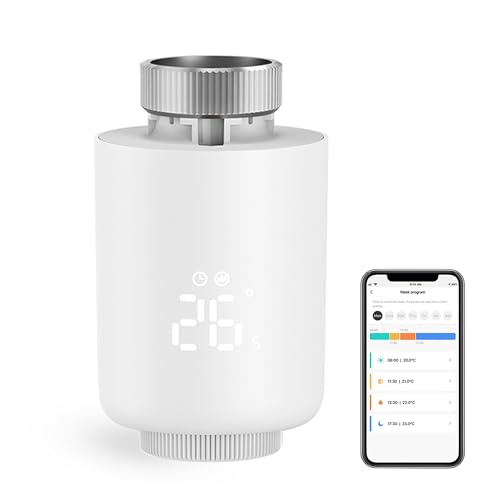
SENCKIT Smart Radiator Thermostat Valve
Best for: zoned radiator and floor heating control
- Connectivity
- Zigbee (what this guide is about)
- System Compatibility
- Floor heating systems
- Smart Home Compatibility
- Alexa, Google Home
- Programmability
- 5+2, 6+1, 7 days
- Display Type
- LCD digital display
- Hub Requirement
- Hub Required
View on Amazon: SENCKIT Smart Radiator Thermostat Valve Affiliate link
You control radiator pipes and floor heating directly with this compact valve controller. It connects over Zigbee rather than Wi-Fi, which requires a separate Zigbee hub for app and voice control via Alexa, Google, and Tuya. It offers 5+2, 6+1, and 7-day schedules with 6 daily periods. This setup suits you if you manage room-by-room hydronic heat.
Pros
- Supports 5+2, 6+1, and 7-day schedules with 6 daily periods
- Wide adjustment range between 5°C and 45°C
- Includes LCD digital display, child lock, and window-opening mode
- Integrates with Alexa, Google Home, and Tuya platforms
Cons
- Requires a standalone Zigbee hub sold separately
- Fits radiator valves and floor heating pipes instead of central HVAC
Good fit if
- You heat with radiators or hydronic floor pipes that use individual valve actuators.
- You maintain or plan to install an external Zigbee network hub.
- You want multi-period weekly scheduling for separate rooms.
Skip if
- You need a wall thermostat for central forced-air heating and cooling.
- You prefer direct Wi-Fi connections that operate without an extra hub.
Verdict: SENCKIT Zigbee Smart Radiator Valve controls individual hydronic heating loops through a dedicated Zigbee hub setup. It fits heating zones where you need targeted valve scheduling instead of a central wall controller.
Specifications side by side
| Spec | Google Nest Smart Wi-Fi Thermostat | SENCKIT Smart Radiator Thermostat Valve |
|---|---|---|
| System Compatibility | not stated | Floor heating systems |
| Wiring Requirement | Works without C wire in most homes | not stated |
| Smart Home Compatibility | Google Assistant, Matter | Alexa, Google Home |
| Programmability | Programmable | 5+2, 6+1, 7 days |
| Connectivity | not stated | Zigbee |
| Display Type | not stated | LCD digital display |
| Hub Requirement | not stated | Hub Required |
| Dimensions | 3.31 × 3.31 × 1.07 inches | 2.17 × 2.17 × 2.91 inches |
| Weight | 4.96 ounces | not stated |
| Size | 1.07 x 3.31 x 3.31 Inches | not stated |
| Color | Sand | White |
| Model | GA02082-US | Zigbee-TRV |
Frequently asked questions
Do I need a hub for a Wi-Fi thermostat?
No, you do not need a separate hub for a Wi-Fi smart thermostat. The Google Nest Thermostat connects directly to your home Wi-Fi network. This allows you to control it using the Google Home app without additional hardware. You simply need an internet connection and the compatible app on your phone.
Is a Zigbee thermostat better for smart home integration?
Zigbee thermostats often offer broader compatibility with existing smart home ecosystems. The SENCKIT Smart Radiator Thermostat Valve works with Alexa, Google Home, and Tuya. However, it requires a Zigbee hub to function. If you already own a compatible hub, this device integrates seamlessly into your current setup for precise temperature management.
Can I control my thermostat remotely with Wi-Fi?
Yes, Wi-Fi thermostats allow remote control from anywhere with an internet connection. The Google Nest Thermostat uses Wi-Fi to sync with the Google Home app. You can adjust schedules and monitor your HVAC system from your mobile device. This direct connection ensures reliable access without relying on a local hub.
Which thermostat is best for radiator systems?
The SENCKIT Smart Radiator Thermostat Valve is designed specifically for radiator systems. It replaces standard radiator valves to provide precise temperature control. This device uses Zigbee connectivity and requires a hub. It is ideal for users with existing radiators who want smart scheduling and voice control through compatible platforms like Alexa or Google Home.
Does the Google Nest Thermostat require a C wire?
The Google Nest Thermostat is designed to work without a C wire in most homes. It draws power from the heating and cooling system wires. This simplifies installation for many users. The device connects via Wi-Fi for smart features. It is a solid choice for Google Home users seeking app control and scheduling.
What size is the Google Nest Thermostat?
The Google Nest Thermostat measures 3.31 inches in width and length, with a height of 1.07 inches. It weighs 4.96 ounces. The device comes in a Sand color finish. Its compact design allows it to fit standard wall plates. These dimensions ensure it blends well with most interior decor styles while providing smart functionality.