Best Smart Thermostats for Line Voltage: 11 Spec-Based Picks
As an Amazon Associate we earn from qualifying purchases. Links on this page are affiliate links.
Selecting the right smart thermostat for line voltage requires matching your heater wiring with the proper electrical rating. We compared 11 models strictly against the specifications published on their product listings. The Honeywell Home Smart Color Touchscreen Thermostat takes the top spot because it combines Wi-Fi connectivity, Energy Star certification, and Alexa voice control for systems with a dedicated C-wire.
This guide helps you decide which thermostat fits your specific circuit voltage, wiring configuration, and scheduling needs.
Quick picks
The best fit for you
- You want Wi-Fi connectivity and Alexa voice control Honeywell Home Smart Color Touchscreen Thermostat This model features integrated Wi-Fi, Alexa compatibility, and Energy Star certification for setups with a dedicated C-wire.
- You need Wi-Fi scheduling for a 4-wire installation KING Hoot Double Pole Smart Line Voltage Thermostat It supports Wi-Fi app programming specifically on dedicated four-wire, double-pole electric heating circuits.
- You need temperature control for a plug-in air conditioner Legacy 120V Plug-In Outlet Thermostat It provides an integrated 120-volt, 15-amp outlet assembly rated for plug-in cooling equipment.
- You want simple manual control for high-wattage baseboards Stelpro 4000W Non-Programmable Line Voltage Thermostat Its non-programmable design handles heating loads up to 4000 watts using a two-wire connection.
Our 11 picks

Honeywell Home Smart Color Touchscreen Thermostat
Best for: smart Wi-Fi control with a C-wire
- System Compatibility
- Line Voltage (what this guide is about)
- Wiring Requirement
- C-wire required
- Smart Home Compatibility
- Alexa
- Programmability
- 7-day
- Display Type
- Color touchscreen
- Certification
- Energy Star Certified
View on Amazon: Honeywell Home Smart Color Touchscreen Thermostat
This unit is a Wi-Fi-enabled programmable thermostat with a customizable color touchscreen and Alexa integration. It carries Energy Star certification and supports flexible seven-day scheduling for your heating and cooling system. You get compatibility with forced air, hot water, steam, and heat pumps with electric backup. It requires a dedicated C-wire connection to operate, making it a fit if your setup provides constant power and you want remote smart controls.
Pros
- Wi-Fi connectivity with Alexa voice integration
- Energy Star certified with demand response program support
- Customizable color touchscreen display
- Flexible 7-day scheduling options
Cons
- Requires a dedicated C-wire connection
- Does not work with electric baseboard heating
Good fit if
- You have a dedicated C-wire installed at your thermostat location.
- You want to manage your schedule through Wi-Fi or Amazon Alexa.
- You use forced air, steam, hot water, or heat pumps with electric backup.
Skip if
- You have electric baseboard heating systems.
- You do not have a C-wire or power adapter available.
Verdict: Honeywell Home Wi-Fi Smart Color Thermostat delivers Wi-Fi app access, Alexa voice control, and seven-day scheduling for systems with a dedicated C-wire. It suits multi-stage heating and cooling setups that do not rely on baseboard heat.

Stelpro Double Pole Line Voltage Thermostat
Best for: high-amperage electric baseboards and wall heaters
- System Compatibility
- Line Voltage (what this guide is about)
- Voltage
- 120–277V
- Wiring Requirement
- Double Pole
- Dimensions
- 4.6 × 2.8 × 2 inches
This mechanical line voltage thermostat manages 120V to 277V electric heating systems up to 22 amps. You turn a manual dial to regulate temperatures across a 50°F to 90°F range. Its double-pole configuration cuts power completely in the off position. This design suits you if you need a straightforward, non-digital control for electric baseboards, fan-forced heaters, or commercial resistance units without network setup.
Pros
- Supports 120–277V systems up to 22 amps
- Double-pole design provides complete power disconnect
- Temperature control range from 50°F to 90°F
- Works with baseboards, fan-forced units, and commercial heaters
Cons
- No Wi-Fi connectivity or remote access
- No digital screen or automated scheduling
Good fit if
- You need a double-pole line voltage switch handling up to 22 amps.
- You operate 120V to 277V electric baseboard or fan-forced heaters.
- You prefer a mechanical dial over digital programming.
Skip if
- You want Wi-Fi connectivity, app control, or smart platform integration.
- You require automated schedules or a digital temperature display.
Verdict: Stelpro Double Pole Line Voltage Thermostat delivers basic manual control for high-amperage 120–277V heating circuits. It provides full-circuit power shutoff without digital complexity.

Cadet Double Pole Line Voltage Thermostat
Best for: manual high-wattage baseboard and wall heater control
- System Compatibility
- Line Voltage (what this guide is about)
- Voltage
- 120V, 208V, 240V
- Wiring Requirement
- 4-wire
- Programmability
- Non-programmable
- Dimensions
- 3 × 6.7 × 9.1 inches
This mechanical line-voltage thermostat controls 120, 208, or 240-volt electric baseboard, fan-forced wall, and convector heaters. It supports up to 22 amps, handling 5,280 watts at 240 volts or 2,640 watts at 120 volts. A double-pole, four-wire setup breaks both power legs for a positive off shutdown. You use a manual twist dial covering 40 to 80 degrees Fahrenheit. It suits you if you need battery-free heater control without complex setup.
Pros
- Handles up to 22 amps and 5,280 watts at 240 volts
- Double-pole design breaks both hot lines with a positive off position
- Mechanical dial requires no batteries or programming
- Color-coded wiring installs directly into standard electrical boxes
Cons
- No Wi-Fi connectivity or smart home integration
- Lacks a digital display and programmable schedules
- Temperature variance ranges between 3 to 6 degrees Fahrenheit
Good fit if
- You need a simple manual control for high-power baseboard or wall heaters up to 22 amps.
- You want a physical double-pole disconnect that completely cuts power at the wall.
- You prefer a twist dial that operates without software setup or batteries.
Skip if
- You want smartphone app control, scheduling, or smart platform integration.
- You require tight digital temperature precision without mechanical dial drift.
Verdict: Cadet Double Pole Line Voltage Dial Thermostat provides high-capacity 22-amp mechanical switching for line-voltage electric heating circuits without needing software or batteries. It serves as a direct manual replacement when smart features are not required.

LUX Programmable Line Voltage Thermostat
Best for: scheduled line-voltage electric heating without blowers
- System Compatibility
- Line Voltage (what this guide is about)
- Programmability
- Programmable
- Dimensions
- 1.75 × 9.5 × 7.5 inches
- Weight
- 1 pounds
The LUX Programmable Line Voltage Thermostat provides automated temperature scheduling for your line-voltage heating system. You get separate weekday and weekend schedules with four daily programming periods, along with a temporary manual override. A positive off switch and front battery access simplify routine maintenance. It suits you if you want scheduled heating control for resistive electric systems without integrated blower fans, keeping daily operation straightforward and predictable.
Pros
- Separate weekday and weekend programming with four daily periods
- Temporary override function for quick temperature adjustments
- Front battery access with a low-battery indicator
- Integrated positive off switch
Cons
- Incompatible with heaters combining resistive elements and inductive blower fans
- No wireless connectivity or smartphone control features listed
Good fit if
- You need distinct weekday and weekend heating schedules on line-voltage wiring.
- You want physical controls featuring quick front battery access and a positive off switch.
Skip if
- You use a heating appliance combining an electric element and a blower fan.
- You require remote app access or smart home platform integration.
Verdict: LUX Programmable Line Voltage Thermostat delivers straightforward weekday and weekend temperature schedules for compatible line-voltage systems. It gives you direct on-screen programming alongside a reliable positive off switch.

Tempro Steel Line Voltage Thermostat
Best for: rugged line-voltage control in harsh environments
- System Compatibility
- Line Voltage (what this guide is about)
- Voltage
- Line Voltage
- Dimensions
- 2 × 2.25 × 5.75 inches
The Tempro Steel Line Voltage Thermostat manages single-stage heating or cooling across a 30°F to 110°F range. It features a gray steel housing built for tough environments and carries UL and cUL listings. Dual Fahrenheit and Celsius scales allow direct temperature tracking. If you need a heavy-duty line-voltage unit that handles demanding conditions, this manual controller suits your workspace.
Pros
- Durable steel housing built for tough environments
- Operates single-stage heating or cooling systems
- Wide operating range from 30°F to 110°F
- UL and cUL listed
- Dual Fahrenheit and Celsius temperature scales
Cons
- No Wi-Fi or smart home connectivity listed
- No digital display screen
- Limited to single-stage equipment
Good fit if
- You need durable steel housing for tough environments.
- You control single-stage heating or cooling between 30°F and 110°F.
- You require UL or cUL certified line-voltage equipment.
Skip if
- You need Wi-Fi control, app integration, or remote access.
- You require multi-stage heating or cooling support.
- You want digital displays or automated schedules.
Verdict: Tempro Steel Line Voltage Thermostat provides rugged steel construction and single-stage climate control spanning 30°F to 110°F. It serves demanding environments requiring mechanical line-voltage switching without digital features.

Robertshaw Mechanical Cooling Line Voltage Thermostat
Best for: manual line-voltage cooling systems
- System Compatibility
- Line Voltage (what this guide is about)
- Voltage
- 120v 240v 277v
- Programmability
- Non-Programmable
View on Amazon: Robertshaw Mechanical Cooling Line Voltage Thermostat
The Robertshaw Mechanical Line Voltage Cooling Thermostat controls line-voltage cooling systems across 120V, 240V, and 277V setups. It operates via a manual mechanical interface with a single-pole, single-throw switch and maintains temperatures between 50°F and 90°F. If you need simple, non-programmable cooling control without smart features or digital displays, this unit fits your installation directly.
Pros
- Supports 120V, 240V, and 277V line-voltage systems
- 50°F to 90°F temperature operating range
- Single-pole, single-throw (SPST) mechanical switch
Cons
- Cooling only with no heating support
- Non-programmable with no Wi-Fi or smart features
Good fit if
- You need a dedicated line-voltage controller exclusively for cooling equipment.
- You require multi-voltage support for 120V, 240V, or 277V electrical setups.
- You prefer a non-programmable, mechanical dial interface.
Skip if
- You need heating control or dual heat-cool capability.
- You want scheduling, Wi-Fi connectivity, or smart automation.
Verdict: Robertshaw Mechanical Line Voltage Cooling Thermostat delivers dedicated cooling management across multiple line-voltage configurations with a direct mechanical control. It provides simple, manual temperature regulation without digital complexity.

Stelpro Non-Programmable 2500W Line Voltage Thermostat
Best for: manual baseboard and convector heating control
- System Compatibility
- Line Voltage (what this guide is about)
- Voltage
- 120V, 208V, 240V
- Wiring Requirement
- Two-wire
- Programmability
- Non-Programmable
- Dimensions
- 1.38 × 4.35 × 4.94 inches
- Weight
- 9.6 ounces
View on Amazon: Stelpro Non-Programmable 2500W Line Voltage Thermostat
This Stelpro non-programmable line voltage thermostat controls electric baseboards and convectors. It connects using a two-wire setup and supports loads up to 1250W at 120V or 2500W at 240V. Built-in thermistor sensing holds temperatures within 1°F, while a dedicated Eco mode lowers output with a single press. It suits you if you need straightforward manual heating control without programming schedules.
Pros
- Holds temperatures within 1°F using thermistor sensing
- Simple two-wire installation for baseboards and convectors
- Supports loads up to 2500W at 240V, 2160W at 208V, and 1250W at 120V
- One-click Eco mode for quick temperature setback
- Backed by a 5-year warranty
Cons
- Not compatible with fan heaters or forced-air units
- Lacks programmable scheduling functions
Good fit if
- You heat with electric baseboards or convectors up to 2500W at 240V.
- You want a basic two-wire setup with quick one-click setback.
Skip if
- You use fan heaters or forced-air heating equipment.
- You require automated schedules or smart network features.
Verdict: Stelpro Non-Programmable 2500W Line Voltage Thermostat delivers precise 1°F temperature regulation and one-touch setback for electric baseboards and convectors. It serves as a dependable two-wire replacement when you do not need automated schedules.

Legacy 120V Plug-In Outlet Thermostat
Best for: Plug-in 120-volt air conditioner units
- System Compatibility
- Line Voltage (what this guide is about)
- Voltage
- 120V
- Application
- Air Conditioners
- Dimensions
- 3 × 4.5 × 6.5 inches
- Weight
- 1.1 pounds
This assembly gives you a line voltage control setup for plug-in 120-volt equipment rated up to 15 amps. You plug your device directly into the integrated three-prong outlet. It manages temperatures between 40°F and 104°F with a 2.5°F differential. You can configure it for heating or cooling via an internal wire terminal change. It suits you if you need direct outlet-based control for a line voltage air conditioner.
Pros
- Integrated standard 3-prong 120V outlet
- Handles electrical loads up to 15 amps
- Selectable heating or cooling operation via terminal change
- Operating temperature span from 40°F to 104°F
Cons
- Switching modes requires manual wire terminal changes
- Differential is fixed at 2.5°F
- No digital display or programming options listed
Good fit if
- You need plug-in 120V control for equipment up to 15 amps.
- You operate cooling or heating gear within a 40°F to 104°F range.
- You use standard 3-prong power cords.
Skip if
- You need automatic switching between heating and cooling modes.
- You require an adjustable temperature differential rather than fixed 2.5°F.
- You need compatibility with voltages higher than 120V.
Verdict: Legacy Line Voltage Thermostat Assembly provides 120-volt, 15-amp regulation for plug-in cooling or heating setups. Its integrated outlet and 40°F to 104°F operating span deliver direct temperature switching without complex installation.

Stelpro 4000W Non-Programmable Line Voltage Thermostat
Best for: high-wattage baseboards needing simple manual control
- System Compatibility
- Line Voltage (what this guide is about)
- Voltage
- 120V, 208V, 240V
- Programmability
- Non-programmable
- Dimensions
- 1.38 × 4.35 × 4.94 inches
- Weight
- 11.2 ounces
View on Amazon: Stelpro 4000W Non-Programmable Line Voltage Thermostat
This Stelpro non-programmable unit controls line voltage baseboards and convectors with up to a 4000W capacity at 240V. It uses a simple two-wire setup and thermistor sensing to regulate heat within 1F increments. You get a push-button Eco mode for quick setbacks without complex scheduling. It suits you if you need a high-capacity, straightforward baseboard controller without smart connectivity or automated programming.
Pros
- Supports high loads up to 4000W at 240V, 3475W at 208V, and 2000W at 120V
- Thermistor sensing maintains temperature within 1F increments
- Eco mode enables one-touch temperature setbacks
- Comes with a sturdy S3 mounting plate and a 5-year warranty
Cons
- Not compatible with fan heaters or forced-air systems
- Lacks programmable schedules and smart Wi-Fi connectivity
Good fit if
- You run standard electric baseboards or convectors pulling up to 4000W.
- You need a basic two-wire line voltage installation.
- You prefer manual control with a single-press Eco setback button.
Skip if
- You have fan-forced wall heaters or forced-air systems.
- You want remote phone control or automated heating schedules.
Verdict: Stelpro 4000W Non-Programmable Line Voltage Thermostat provides precise 1F temperature regulation for high-capacity baseboards and convectors. It offers dependable two-wire manual operation without the setup demands of smart hardware.

KING Hoot Double Pole Smart Line Voltage Thermostat
Best for: 4-wire smart line voltage heating control
- System Compatibility
- Line Voltage (what this guide is about)
- Voltage
- 120/208/240V
- Wiring Requirement
- Double pole, 4-wire
- Programmability
- Programmable (4 or 6 periods/day)
- Display Type
- LCD touchscreen
- Connectivity
- Wi-Fi
View on Amazon: KING Hoot Double Pole Smart Line Voltage Thermostat
The KING Hoot Double Pole Smart Line Voltage Thermostat provides Wi-Fi app control for electric heating systems running on 120V, 208V, or 240V circuits. It requires a 4-wire double pole setup and includes a large LCD touchscreen display with over-the-air firmware updates. You can set four or six daily program periods and lock a maximum temperature. It suits you if you need scheduled smart control over high-voltage baseboard or wall heaters.
Pros
- Multi-volt rated for 120V, 208V, and 240V installations
- App-based scheduling with 4 or 6 daily time periods
- Large LCD touchscreen with temperature lock feature
- Over-the-air firmware update support
Cons
- Requires a 4-wire connection and cannot operate on 2-wire circuits
- Not compatible with low-voltage 24V central HVAC systems
Good fit if
- You have a 120V, 208V, or 240V line-voltage setup with 4 wires.
- You want Wi-Fi schedule management with 4 or 6 periods per day.
- You need a hardware-level maximum temperature lock.
Skip if
- You have a standard 24V low-voltage heating and cooling system.
- Your electrical box only provides 2 or 3 wires.
Verdict: KING Hoot Double Pole Smart Line Voltage Thermostat delivers app-based scheduling and multi-volt compatibility for dedicated 4-wire heating circuits. Its touchscreen interface and configurable daily periods provide precise control over high-voltage electric heaters.
White-Rodgers Digital Line Voltage Thermostat
Best for: manual line voltage heating control
- System Compatibility
- Line Voltage (what this guide is about)
- Voltage
- 240-VoltAC
- Programmability
- Non-Programmable
- Display Type
- Digital
- Dimensions
- 5 × 4.2 × 1.25 inches
- Weight
- 4 ounces
View on Amazon: White-Rodgers Digital Line Voltage Thermostat
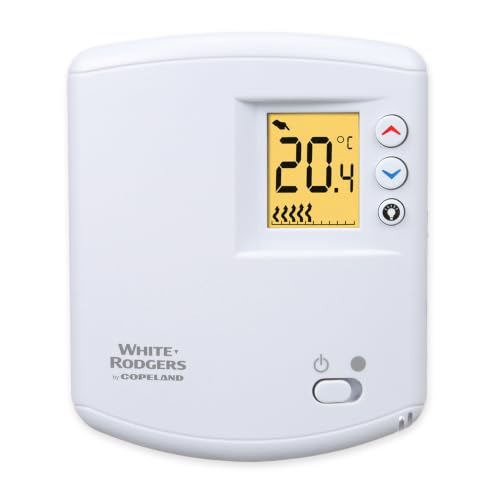
The White-Rodgers Digital Line Voltage Thermostat is a non-programmable digital unit built for high-voltage heating systems. You can connect it to either single-pole or double-pole wiring configurations. It manages loads ranging from 250 watts to 4000 watts at 240 volts AC, and it includes an installation backplate. This unit suits you if you want manual temperature adjustment without programming schedules.
Pros
- Supports both single-pole and double-pole wiring setups
- Handles up to 4000 watts maximum power at 240 volts AC
- Includes an easy-to-install backplate
- Compact and lightweight at 0.25 pounds
Cons
- Non-programmable with no scheduling capability
- Requires a minimum load of 250 watts at 240 volts AC
- Lacks Wi-Fi and smart connectivity options
Good fit if
- You need a line voltage thermostat for single-pole or double-pole applications.
- You operate heating equipment between 250 and 4000 watts at 240 volts AC.
Skip if
- You want programmable schedules to automate heating routines.
- You need remote phone control or Wi-Fi features.
Verdict: White-Rodgers Digital Line Voltage Thermostat provides flexible single- or double-pole compatibility and supports loads up to 4000 watts. It is a solid choice if you prefer a dedicated digital control without programming requirements.
Specifications side by side
| Spec | Honeywell Home Smart Color Touchscreen Thermostat | Stelpro Double Pole Line Voltage Thermostat | Cadet Double Pole Line Voltage Thermostat | LUX Programmable Line Voltage Thermostat | Tempro Steel Line Voltage Thermostat | Robertshaw Mechanical Cooling Line Voltage Thermostat | Stelpro Non-Programmable 2500W Line Voltage Thermostat | Legacy 120V Plug-In Outlet Thermostat | Stelpro 4000W Non-Programmable Line Voltage Thermostat | KING Hoot Double Pole Smart Line Voltage Thermostat | White-Rodgers Digital Line Voltage Thermostat |
|---|---|---|---|---|---|---|---|---|---|---|---|
| System Compatibility | Forced air, hot water, steam, heat pumps | Baseboards, fan-forced units | Electric baseboard, wall, convector | Line Voltage | Heating & Cooling, Single Stage | Cool Only | Electric baseboards and convectors | not specified | Electric baseboards, convectors | Baseboard, fan forced, radiant electric | Line Voltage |
| Voltage | not specified | 120–277V | 120V, 208V, 240V | not specified | Line Voltage | 120v 240v 277v | 120V, 208V, 240V | 120V | 120V, 208V, 240V | 120/208/240V | 240-VoltAC |
| Wiring Requirement | C-wire required | Double Pole | 4-wire | not specified | not specified | not specified | Two-wire | not specified | not specified | Double pole, 4-wire | not specified |
| Smart Home Compatibility | Alexa | not specified | not specified | not specified | not specified | not specified | not specified | not specified | not specified | not specified | not specified |
| Programmability | 7-day | not specified | Non-programmable | Programmable | not specified | Non-Programmable | Non-Programmable | not specified | Non-programmable | Programmable (4 or 6 periods/day) | Non-Programmable |
| Display Type | Color touchscreen | not specified | not specified | not specified | not specified | not specified | not specified | not specified | not specified | LCD touchscreen | Digital |
| Certification | Energy Star Certified | not specified | not specified | not specified | not specified | not specified | not specified | not specified | not specified | not specified | not specified |
| Connectivity | Wi-Fi | not specified | not specified | not specified | not specified | not specified | not specified | not specified | not specified | Wi-Fi | not specified |
| Application | not specified | not specified | not specified | not specified | not specified | not specified | not specified | Air Conditioners | not specified | not specified | not specified |
| Dimensions | 3.5 × 4.5 × 0.88 inches | 4.6 × 2.8 × 2 inches | 3 × 6.7 × 9.1 inches | 1.75 × 9.5 × 7.5 inches | 2 × 2.25 × 5.75 inches | not specified | 1.38 × 4.35 × 4.94 inches | 3 × 4.5 × 6.5 inches | 1.38 × 4.35 × 4.94 inches | 10 × 10 × 10 inches | 5 × 4.2 × 1.25 inches |
| Weight | 14.4 ounces | not specified | not specified | 1 pounds | not specified | not specified | 9.6 ounces | 1.1 pounds | 11.2 ounces | not specified | 4 ounces |
| Size | 1 (Pack of 2) | 2 Poles | No Size | Traditional | not specified | not specified | ST252NP - 2500W | not specified | ST402NP - 4000W | Double Pole (4-Wire) | not specified |
| Color | Gray | White | White | White | Gray | White | White | Gray | White | Black | White |
| Model | RTH9585WF1004/W | SWT2F | T522-W | ELV4 | TP500 | 803A | ST252NP - 2500W | 900148 | ST402NP - 4000W | K902-B | 1E65-144 |
Is a Line Voltage Thermostat Worth It?
A line-voltage thermostat directly switches power for high-voltage heating and cooling equipment. These models manage 120V to 277V circuits, supporting resistive loads up to 4000 watts or 22 amps without external relays. In daily operation, choosing line voltage hardware allows direct control over electric baseboards, convectors, wall heaters, or plug-in air conditioners. Depending on the unit's specifications, your daily interaction ranges from manual mechanical dials to digital schedules or Wi-Fi mobile access.
Worth it if
- You need to regulate electric baseboard, wall heater, or convector loads powered by 120V to 277V circuits.
- You use a dedicated plug-in 120-volt air conditioner that requires direct 15-amp outlet regulation.
- You need direct high-capacity electrical switching supporting loads up to 22 amps or 4000 watts.
Skip it if
- You operate standard heating or cooling equipment that does not run on 120V to 277V electrical wiring.
- You do not use high-wattage baseboards, wall heaters, convectors, or plug-in cooling appliances.
For cooling needs, see our guide to the best refrigerators with adjustable thermostat, compared.
How We Picked Line Voltage Thermostats
You find 11 line-voltage options in this guide, chosen strictly by published specifications. A thermostat qualifies when its listing states line-voltage compatibility directly in the title or feature details. Each product family includes only one representative variant. All information comes straight from published manufacturer data without physical handling.
Eligible models are ordered with products in stock first, then by Amazon sales rank so better-selling products appear first. We also compare published specifications such as wiring requirements, programmability, Wi-Fi connectivity, and physical dimensions. This spec-based breakdown helps you choose the right control for your line-voltage heating or cooling setup.
Key Specs for Choosing Line Voltage Thermostats
-
Choose Programmable or Manual Control
Check the programmability specification to decide between automated schedules and manual adjustments. If you want predetermined daily temperature changes without regular intervention, select a programmable unit. The LUX Programmable Line Voltage Thermostat provides weekday and weekend programming options along with a positive off switch directly on the unit. Conversely, non-programmable mechanical or digital models suit spaces where you prefer manual temperature setting whenever needed. Compare listed scheduling options to verify whether the device supports multi-day schedules or strictly direct manual operation.
-
Evaluate Voice Assistant Compatibility
Review the smart home compatibility specification if you plan to integrate the thermostat into your existing connected ecosystem. If you use voice assistants to manage room climate, look for models with explicit platform integration. The Honeywell Home Smart Color Touchscreen Thermostat lists direct Alexa compatibility alongside Wi-Fi connectivity for app-based adjustments. If you do not use voice control or connected assistants, a basic non-connected thermostat eliminates unnecessary network setup. Always confirm the exact voice assistant listed under the smart home specs to ensure seamless communication with your current equipment.
-
Match Maximum Wattage Limits
Verify the maximum wattage specification against the total electrical load of your connected heating equipment. Baseboard heaters and convectors draw substantial power, so the thermostat must handle your circuit capacity safely. The Stelpro Non-Programmable 2500W Line Voltage Thermostat is rated for setups up to 2500 watts, making it suitable for moderate room heaters. Larger rooms with multiple baseboards on a single circuit require higher limits, such as 4000 watts. Sum the wattage of every heater controlled by the switch and confirm the thermostat rating meets or exceeds that total sum.
-
Verify Dedicated Cooling Support
Examine whether the thermostat specifications designate heating or cooling operation. While many line-voltage controls manage baseboard or wall heat, cooling applications require switches engineered specifically for air conditioning equipment. The Robertshaw Mechanical Cooling Line Voltage Thermostat provides mechanical cooling regulation across 120V, 240V, and 277V systems. Selecting a heating-only model for an air conditioner results in inverted temperature behavior. Check the product specifications for explicit cooling designations and verify that the operating voltage matches your cooling installation before making a choice.
-
Assess Environmental Housing Construction
Inspect the housing material and temperature operating range if you install the control outside standard finished rooms. Standard plastic casings suit residential bedrooms and living spaces, but utility rooms, workshops, or outbuildings require heavy-duty components. The Tempro Steel Line Voltage Thermostat features a steel enclosure and supports a broad operating span from 30°F to 110°F. Compare the physical material and temperature limits in the specifications to ensure the enclosure withstands the physical impacts and environmental temperatures of your intended installation location.
-
Check Installation Form Factor
Determine whether your equipment connects through an electrical wall box or a standard receptacle. Hardwired line-voltage thermostats mount directly into electrical wall junction boxes, controlling permanent baseboard or wall heaters. If you need temperature regulation for portable units or window air conditioners, look for an integrated receptacle design. The Legacy 120V Plug-In Outlet Thermostat provides a built-in 15-amp outlet that handles 120-volt plug-in equipment without wall box wiring. Check the mounting style and plug type specifications to confirm physical installation compatibility with your space.
Frequently asked questions
Can you control line-voltage thermostats with Wi-Fi or voice assistants?
Yes, specific line-voltage thermostats support Wi-Fi networks and voice assistants like Alexa. For example, the Honeywell Home Smart Color Touchscreen Thermostat features built-in Wi-Fi connectivity and Alexa smart home compatibility. Another smart option, the KING Hoot Double Pole Smart Line Voltage Thermostat, provides Wi-Fi support and app-based scheduling. Check your circuit wiring carefully, as smart models often require dedicated wiring setups such as a C-wire or a four-wire configuration.
What is the difference between single-pole and double-pole line-voltage thermostats?
Single-pole thermostats switch only one hot wire, while double-pole models interrupt both hot wires to fully cut power. A double-pole unit, such as the Cadet Double Pole Line Voltage Thermostat or Stelpro SWT2F, provides a true mechanical off position that disconnects the circuit entirely. Single-pole models, like the Robertshaw 803A cooling thermostat, maintain a low minimum temperature setting rather than cutting power completely.
Do you need a C-wire to install a smart line-voltage thermostat?
You only need a C-wire if the specific thermostat listing states it as an explicit wiring requirement. For instance, the Honeywell Home Smart Color Touchscreen Thermostat lists a C-wire as mandatory to power its Wi-Fi radio and color display. Other connected models use alternate wiring topologies; the KING Hoot smart thermostat requires a dedicated four-wire setup instead. Always verify terminal requirements against your junction box wiring before installation.
Can you use a line-voltage thermostat for cooling or air conditioners?
Yes, certain line-voltage models are built specifically for cooling equipment and direct plug-in appliances. The Robertshaw 803A provides dedicated mechanical single-pole cooling control across standard 120V, 240V, and 277V systems. For portable equipment, the Legacy 120V Plug-In Outlet Thermostat regulates plug-in air conditioners up to 15 amps across a 40°F to 104°F span without hardwiring into wall boxes.
What wattage capacity do line-voltage thermostats support?
Wattage capacities vary by model, ranging from moderate resistive loads up to 4000 watts. For instance, the Stelpro ST252NP manages loads up to 2500W, while the Stelpro ST402NP and White-Rodgers 1E65-144 handle higher-demand heating equipment up to 4000 watts. You must calculate the combined wattage of all baseboards or wall heaters on the circuit to ensure total power draw stays within the specified maximum rating.
How do programmable and non-programmable line-voltage thermostats differ?
Programmable line-voltage thermostats let you configure automated temperature schedules, while non-programmable versions require manual adjustment. Units like the LUX ELV4 or KING Hoot offer programmable schedules for automated setback periods throughout the week. In contrast, non-programmable options like the Stelpro ST402NP or White-Rodgers Digital Line Voltage Thermostat focus on manual digital input or direct dial control without storing recurring schedule profiles.