Broadlink RM4 Pro IR RF vs Broadlink RM MAX IR RF: Spec Comparison
As an Amazon Associate we earn from qualifying purchases. Links on this page are affiliate links.
This broadlink rm4 pro ir rf vs rm max ir rf comparison helps you decide between two universal hubs. Both devices control IR and RF appliances via 2.4 GHz Wi-Fi and support Alexa and Google Home. They share the BroadLink app ecosystem. The main difference lies in connectivity and offline capabilities. The RM MAX adds Bluetooth Low Energy for local control and offline scene storage. The RM4 Pro supports an external temperature and humidity sensor via USB.
Key differences
| Aspect | BroadLink RM4 Pro IR and RF Smart Hub | Broadlink RM MAX IR and RF Smart Hub |
|---|---|---|
| Connectivity | IR, RF (433MHz), Wi-Fi | IR 38KHz, RF 433MHz, BLE, FastCon |
| Offline Control | Not listed | Local BLE control; scenes stored on hub |
| External Sensors | Supports USB temp/humidity sensor | Not listed |
| Dimensions | 3.35 x 1.22 x 3.35 inches | 4.28 x 1.44 x 4.28 inches |
Which one should you choose?
Choose BroadLink RM4 Pro IR and RF Smart Hub if
- You need to monitor room temperature and humidity with an external USB sensor
- You prefer a more compact device for discreet placement
- You want to use FastCon technology for zero-configuration device discovery
Choose Broadlink RM MAX IR and RF Smart Hub if
- You require offline control for scenes during Wi-Fi outages
- You want faster device setup using Bluetooth Low Energy
- You need to manage FastCon smart bulbs and sensors directly through the hub
Verdict: Choose the RM4 Pro if you need external sensor integration and a smaller footprint. The RM MAX is better for users who rely on offline scene execution and local BLE control. Both hubs effectively manage IR and RF devices through voice assistants.
RM4 Pro vs RM MAX Specs
connectivity
The BroadLink RM4 Pro relies on IR, RF at 433MHz, and 2.4 GHz Wi-Fi for connectivity. It does not support Bluetooth. The BroadLink RM MAX adds BLE (Bluetooth Low Energy) to its IR 38KHz, RF 433MHz, and 2.4 GHz Wi-Fi setup. This BLE support allows for faster device discovery and local control. You can manage devices locally through BLE even if your Wi-Fi network goes down. The RM MAX also integrates FastCon technology for smart bulbs and sensors. The RM4 Pro uses FastCon for automatic device discovery but lacks the local BLE control layer found in the RM MAX.
offline control
The BroadLink RM MAX ensures reliable offline control by storing custom scenes directly on the hub. Once configured, devices can be managed locally through BLE. This means your scenes, like a Good Morning routine, continue to run smoothly during network outages. The BroadLink RM4 Pro does not mention local offline scene storage or BLE-based local control in its specifications. It relies on cloud updates for compatibility and remote access. If your internet connection fails, the RM4 Pro may not execute automated scenes without external network access. The RM MAX offers a distinct advantage for users who need uninterrupted automation.
smart home compatibility
Both hubs support Alexa and Google Home for voice control. The BroadLink RM4 Pro is compatible with Alexa for controlling TVs, STBs, air conditioners, and fans. It also works with Google Home for air conditioners and IFTTT for automation. The BroadLink RM MAX supports Alexa and Google Home as well. However, it notes a specific limitation: devices added via preset panels work with voice assistants, but buttons created in learning mode cannot be recognized individually by voice. You must create custom scenes in the Magic Home app to link learned devices to voice assistants. Both offer similar core compatibility, but the RM MAX requires extra steps for learned devices.
app ecosystem
The BroadLink RM4 Pro uses the new BroadLink app, which features better user experiences for configuration and scene creation compared to the older IHC app. It also allows you to test IR devices using an Android phone with an IR emitter. The BroadLink RM MAX uses the Broadlink Magic Home app, which delivers a refined interface and integrates FastCon-enabled smart bulbs and sensors. The RM MAX acts as a hub for this ecosystem. Both apps support the FastCon technology for automatic device discovery. The RM4 Pro highlights the testing feature for IR devices, while the RM MAX emphasizes the integration with FastCon sensors and bulbs.
sensors
The BroadLink RM4 Pro supports an external Temperature and Humidity Sensor via a USB cable, which is purchased separately. When connected, the BroadLink App displays room temperature and humidity. The BroadLink RM MAX integrates with FastCon sensors, including motion, door, and temperature/humidity sensors. It acts as a smart hub for managing these FastCon-enabled sensors. The RM4 Pro requires a specific USB cable for its sensor, while the RM MAX supports a broader range of FastCon sensors through its app integration. Both allow you to monitor environmental conditions, but the RM MAX offers more sensor variety within its ecosystem.
Which Broadlink hub fits your needs
Users needing offline automation reliability
The RM MAX stores custom scenes directly on the hub. It uses BLE for local control, ensuring devices work even if Wi-Fi fails. This offline capability keeps routines like bedtime or morning scenes running smoothly without an internet connection, offering greater reliability for essential daily automations.
Those wanting precise sensor integration
The RM4 Pro supports an external temperature and humidity sensor via a USB cable. The app displays this data directly. This feature allows you to monitor room conditions more accurately than the RM MAX, which lacks specific mention of external sensor hardware support in its listed specifications.
Buyers wanting compact device dimensions
The RM4 Pro measures 3.35 inches square and weighs 5.29 ounces. The RM MAX is larger at 4.28 inches square and 1.44 inches high. If you need a smaller footprint for discreet placement, the RM4 Pro’s compact physical profile offers a more space-efficient solution for your setup.
Users preferring faster initial setup
The RM MAX features BLE for quick device discovery and faster configuration. It integrates FastCon technology to automatically detect compatible bulbs and sensors. This streamlined setup process reduces the time needed to get your smart home ecosystem running compared to the standard Wi-Fi pairing method used by the RM4 Pro.
The products compared
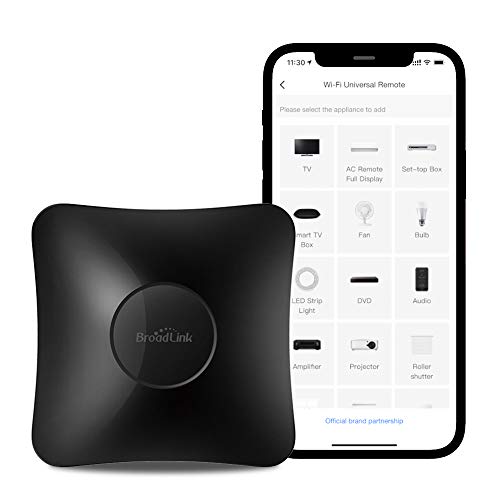
BroadLink RM4 Pro IR and RF Smart Hub
Best for: Users needing IR and RF control with voice support
- Connectivity
- IR, RF (433MHz), Wi-Fi
- Smart Home Compatibility
- Alexa, Google Home, IFTTT
- Network Interface
- 2.4 GHz Wi-Fi
- Application
- Air Conditioners, Televisions
- Dimensions
- 3.35 × 3.35 × 1.22 inches
- Weight
- 5.29 ounces
View on Amazon: BroadLink RM4 Pro IR and RF Smart Hub Affiliate link
The Broadlink RM4 Pro acts as a universal remote hub using IR and 433 MHz RF signals. It connects via 2.4 GHz Wi-Fi and supports voice control through Alexa and Google Home. The device learns codes for over 50,000 devices and includes FastCon technology for automatic discovery. You can monitor room conditions by connecting an external temperature and humidity sensor. It is designed for users who need a single hub to manage various household electronics.
Pros
- Supports both IR and 433 MHz RF signals for broad device compatibility
- Compatible with Alexa, Google Home, and IFTTT for voice and automation control
- Includes FastCon technology for automatic device discovery after initial setup
- Allows connection of an external USB temperature and humidity sensor
Cons
- Only supports 2.4 GHz Wi-Fi networks
- Does not work with Bluetooth devices
- External temperature and humidity sensor is sold separately
Good fit if
- You need a single hub to control both IR and RF devices like curtains or projectors
- You want to monitor room temperature and humidity through your smart home app
- You use Alexa or Google Home for voice control of your electronics
Skip if
- You only have 5 GHz Wi-Fi networks available
- You want to control Bluetooth devices directly
- You prefer a remote that includes all necessary sensors in the box
Verdict: Broadlink RM4 Pro IR RF Remote is a practical hub for users who need to control both infrared and radio frequency devices through a single app. It fits buyers who want to add voice control and environmental monitoring to their existing smart home setup.

Broadlink RM MAX IR and RF Smart Hub
Best for: RF device control and offline scene automation
- Connectivity
- IR 38KHz, RF 433MHz, BLE, FastCon
- Smart Home Compatibility
- Alexa, Google Home
- Network Interface
- 2.4GHz Wi-Fi
- Dimensions
- 4.28 × 4.28 × 1.44 inches
View on Amazon: Broadlink RM MAX IR and RF Smart Hub Affiliate link
The Broadlink RM MAX is a smart hub supporting IR 38KHz and RF 433MHz signals. It connects via 2.4GHz Wi-Fi and uses BLE for quick setup. You can control devices locally or remotely. It works with Alexa and Google Home. The unit measures 4.28 by 1.44 inches. It suits users wanting unified control for fans, blinds, and audio systems through one app.
Pros
- Supports IR 38KHz and RF 433MHz signals
- BLE for fast local device discovery
- Compatible with Alexa and Google Home
- Stores custom scenes for offline use
Cons
- Voice assistants cannot control individually learned buttons
- Requires 2.4GHz Wi-Fi network only
- No 5GHz Wi-Fi support mentioned
Good fit if
- You want to control RF fans and roller blinds
- You need reliable offline scene execution
- You prefer local BLE setup over cloud pairing
Skip if
- You require 5GHz Wi-Fi connectivity
- You need direct voice control for learned IR codes
- You want to manage devices without an app
Verdict: Broadlink RM MAX IR RF Hub offers solid IR and RF coverage with local BLE setup. It fits users who need offline scene reliability and RF device support, provided you accept the voice control limits for learned codes.
Specifications side by side
| Spec | BroadLink RM4 Pro IR and RF Smart Hub | Broadlink RM MAX IR and RF Smart Hub |
|---|---|---|
| Connectivity | IR, RF (433MHz), Wi-Fi | IR 38KHz, RF 433MHz, BLE, FastCon |
| Smart Home Compatibility | Alexa, Google Home, IFTTT | Alexa, Google Home |
| Network Interface | 2.4 GHz Wi-Fi | 2.4GHz Wi-Fi |
| Application | Air Conditioners, Televisions | not stated |
| Dimensions | 3.35 × 3.35 × 1.22 inches | 4.28 × 4.28 × 1.44 inches |
| Weight | 5.29 ounces | not stated |
| Color | Black | not stated |
| Model | 6734134 | RM MAX |
Frequently asked questions
Does the BroadLink RM4 Pro support Bluetooth for setup?
No, it does not. The RM4 Pro relies on Wi-Fi connectivity for pairing and control. It uses infrared and radio frequency signals to manage devices like air conditioners and televisions. You must connect it to your 2.4 GHz network to use its smart home features with Alexa or Google Home.
Which hub is better for offline scene automation?
The BroadLink RM MAX is better for this. It stores custom scenes directly on the device. This allows routines to run even if your Wi-Fi connection fails. It uses Bluetooth Low Energy for local control, ensuring reliability for bedtime or morning scenes without needing an active internet connection.
Can I control my TV with both devices?
Yes, both hubs can control televisions. They both use infrared signals to send commands to your TV. You can also manage other appliances using their radio frequency capabilities. Both devices work with the BroadLink app, allowing you to create custom controls for your television and other IR-compatible electronics.
Is the RM MAX larger than the RM4 Pro?
Yes, the RM MAX is physically larger. The RM4 Pro measures 3.35 inches in width and length. The RM MAX is 4.28 inches in width and length. The RM MAX also has a slightly greater height at 1.44 inches compared to the RM4 Pro's 1.22 inches.
Do both hubs work with voice assistants?
Yes, both devices support Alexa and Google Home. You can use voice commands to control connected IR and RF appliances. This compatibility allows you to integrate either hub into your existing smart home ecosystem. You can manage your devices through voice commands once the hubs are linked to your preferred assistant.
Does the RM MAX support Bluetooth for device control?
It supports Bluetooth Low Energy for local setup and control. This feature helps maintain functionality when Wi-Fi is down. However, voice control limits may apply to learned codes. The RM MAX uses BLE to ensure reliable operation for your RF and IR devices during local automation routines.