Aqara M100 Matter Zigbee Hub Review (2026): A Spec-Based Look
As an Amazon Associate we earn from qualifying purchases. Links on this page are affiliate links.
This aqara smart hub m100 home review focuses on the M100’s role as a multi-protocol controller. It supports Thread and Zigbee devices, acting as a Matter bridge to connect Aqara products with other ecosystems. The hub runs on 2.4GHz Wi-Fi 6 and draws power via a USB-A port. It allows local automation for reliable performance. This design prioritizes integration across platforms while maintaining speed and security. You get a compact device that fits into various smart home setups. The M100 aims to unify your connected devices through standardized protocols.
What stands out
- Supports up to 20 Aqara Zigbee and 20 Thread devices
- Acts as a Matter Bridge for cross-ecosystem compatibility
- Enables local automation execution for faster response times
- Connects via 2.4GHz Wi-Fi 6 with WPA3 security
- Adjustable shaft allows 210-degree placement flexibility
Who it fits
Good fit for
This hub suits users who own Aqara Zigbee devices and want to integrate them with Apple Home, Amazon Alexa, or Home Assistant. It is ideal for those who value local automation for reliability without cloud dependency. If you need a Matter bridge to expand your smart home with third-party devices, this unit fits your needs. The flexible power options and small size also make it suitable for renters or those with limited outlet space.
Who should skip it
You should look elsewhere if you need support for third-party Zigbee devices, as the M100 only supports Aqara Zigbee products. It also requires a continuous power source via USB-A, which may be inconvenient if you lack nearby ports. The hub must stay within 6 to 19 feet of your router for stable Wi-Fi 6 connectivity. If you require 5GHz Wi-Fi or built-in batteries, this model does not offer those features.
Verdict: The Aqara M100 is a practical bridge for Aqara users expanding into Matter ecosystems. Its local automation and flexible power options make it a solid choice for specific smart home setups.
Aqara M100 Key Specs Explained
Connectivity: Thread, Zigbee, Matter, Wi-Fi
This hub uses multiple wireless standards to connect different devices. Thread and Zigbee allow low-power sensors and lights to join your network. Matter acts as a bridge, letting Aqara Zigbee devices work with Apple Home or Home Assistant. Wi-Fi connects the hub itself to your router. This mix helps you combine brands without needing separate hubs for each protocol.
Network Interface: 2.4GHz Wi-Fi 6
The hub connects to your router using the 2.4GHz band with Wi-Fi 6 support. This standard handles more devices at once with less interference than older Wi-Fi versions. You get faster data transfer and better stability when many smart home devices are active. Place the hub six to nineteen feet from your router for the best signal strength and reliable performance.
Smart Home Compatibility: Apple Home, Amazon Alexa, Home Assistant
The M100 integrates with major platforms like Apple Home, Amazon Alexa, and Home Assistant. As a Matter bridge, it exposes Aqara Zigbee devices to these ecosystems. This means you can control sensors and switches through voice assistants or third-party automation tools. It is ideal if you already use one of these platforms and want to add Aqara hardware without switching apps.
Power Source: USB-A
The hub draws power through a standard USB-A port. You can plug it into a wall adapter, power bank, or computer. This flexibility lets you place the hub near existing outlets or USB ports without searching for dedicated power strips. Ensure you use a 5V 0.5A adapter for proper operation. The compact design keeps the cable tidy in your setup.
Aqara M100 Design and Build
The Aqara M100 is a compact hub with a minimalist form factor. According to the listing, its dimensions are 4.25 inches in length, 1.18 inches in height, and 0.31 inches in width. It weighs just 0.71 ounces. This small footprint allows you to place it on a shelf, desk, or nightstand without taking up much space. The low weight means it can be moved easily if you change your smart home layout.
A key design feature is the adjustable shaft. The listing states the shaft can rotate within a 210-degree range. This flexibility lets you angle the hub toward your router for better signal or orient it for convenient access to the USB port. You can plug a standard USB-A cable into the hub to power it. This port also allows you to connect the device to power banks, wall adapters, or routers, giving you multiple setup options.
The build prioritizes functional placement over decorative appeal. The simple cylindrical shape and adjustable base mean you can hide it in corners or position it centrally in a room. You do not need to mount it on a wall. The design focuses on keeping the hub close to your router, as the listing recommends placing it between 6 to 19 feet away for stable Wi-Fi 6 connectivity. This approach ensures reliable local automation execution without requiring complex installation.
Aqara M100 Setup And Use
Setup begins with a simple power connection. The Aqara M100 uses a standard USB-A port, allowing you to plug it into a power bank, wall adapter, or router. The listing notes that a 5V⎓0.5A power adapter is not included, so you must provide your own. For network placement, keep the hub between 6 and 19 feet from your Wi-Fi router to ensure stable 2.4GHz Wi-Fi 6 connectivity with WPA3 security. The device features an adjustable shaft that rotates 210 degrees, giving you flexible positioning options for optimal signal strength.
In daily use, the hub manages up to 20 Aqara Zigbee devices and 20 Thread devices. It acts as a Matter bridge, enabling these products to communicate with Apple Home, Amazon Alexa, and Home Assistant. This setup allows unique Aqara features, like facial recognition, to function across different ecosystems. The M100 supports local automation execution for Zigbee and Matter devices. This means commands process with millisecond-level response times, even if your internet connection drops. Only cloud-dependent tasks, such as push notifications, require an active online connection. The hub currently supports lights, thermostats, plugs, switches, buttons, and various sensors for motion, light, door, window, and temperature. This local processing ensures reliable performance for your smart home routines without constant cloud dependency.
Before You Buy The Aqara M100
Before you buy the Aqara M100, verify your existing smart home ecosystem. This hub acts as a Matter bridge, connecting Aqara Zigbee devices to platforms like Apple Home, Amazon Alexa, or Home Assistant. It does not support third-party Zigbee devices, so confirm your sensors are Aqara-branded. You must provide your own 5V⎓0.5A power adapter, as it is not included. The unit requires a stable 2.4GHz Wi-Fi 6 connection. Place it between 6 to 19 feet from your router for optimal performance. Local automation runs smoothly even if the cloud disconnects, but cloud-dependent features like push notifications need internet access. The adjustable shaft allows flexible placement. Consider this hub if you want to expand Aqara’s facial recognition and complex automations into other Matter-compatible systems. It fits well alongside other smart home controls for users seeking cross-ecosystem integration without sacrificing local reliability.
Check before you buy
- Confirm your sensors are Aqara Zigbee, not third-party.
- Provide your own 5V⎓0.5A USB-A power adapter.
- Ensure your router supports 2.4GHz Wi-Fi 6.
- Place the hub 6 to 19 feet from the router.
The product at a glance
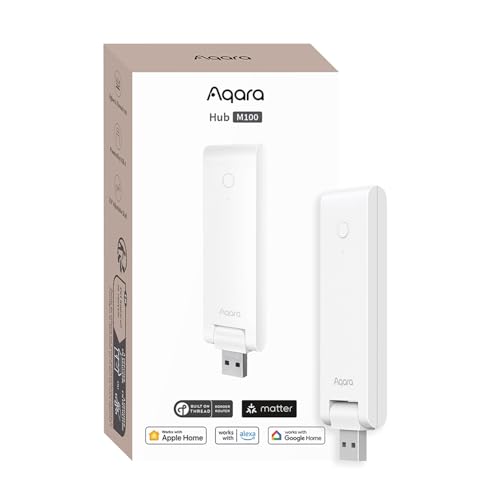
Aqara M100 Matter and Zigbee Hub
Best for: Aqara device integration into Matter ecosystems
- Connectivity
- Zigbee, Thread, Wi-Fi 6, Matter
- Smart Home Compatibility
- Apple HomeKit, Alexa, Home Assistant
- Network Interface
- 2.4GHz Wi-Fi 6, USB-A
- Power Source
- 5V 0.5A USB-A
- Dimensions
- 4.25 × 0.31 × 1.18 inches
- Weight
- 0.71 ounces
View on Amazon: Aqara M100 Matter and Zigbee Hub Affiliate link
The Aqara M100 is a multi-protocol smart hub supporting Thread, Zigbee, and Matter. It connects up to 20 Aqara Zigbee devices and 20 Thread devices. The hub uses 2.4GHz Wi-Fi 6 for stable local automation with millisecond response times. Its adjustable shaft allows flexible placement. This hub suits users wanting to bridge Aqara devices to Apple Home, Alexa, or Home Assistant.
Pros
- Supports Thread, Zigbee, and Matter protocols
- Local automation execution for reliable performance
- Adjustable 210-degree mounting shaft
- 2.4GHz Wi-Fi 6 with WPA3 security
Cons
- Limited to 20 Aqara Zigbee devices
- Does not support third-party Zigbee devices
- Requires separate 5V power adapter
Good fit if
- You use Aqara Zigbee sensors and switches
- You want local automation without cloud dependency
- You need to bridge devices to Home Assistant
Skip if
- You need to control third-party Zigbee devices
- You require 5GHz Wi-Fi connectivity
- You want a built-in power supply
Verdict: Aqara M100 Matter Zigbee Hub is a compact bridge for Aqara ecosystems, ideal for users integrating Thread and Zigbee devices into Matter-based smart homes.
Specifications side by side
| Spec | Aqara M100 Matter and Zigbee Hub |
|---|---|
| Connectivity | Zigbee, Thread, Wi-Fi 6, Matter |
| Smart Home Compatibility | Apple HomeKit, Alexa, Home Assistant |
| Network Interface | 2.4GHz Wi-Fi 6, USB-A |
| Power Source | 5V 0.5A USB-A |
| Dimensions | 4.25 × 0.31 × 1.18 inches |
| Weight | 0.71 ounces |
| Model | HM-G02E |
Frequently asked questions
Does the Aqara M100 support Apple Home?
Yes, the Aqara M100 supports Apple Home. It acts as a Matter bridge, allowing Aqara Zigbee devices to integrate with Apple’s ecosystem. This enables you to control compatible sensors and lights through Siri or the Home app. The hub connects via Thread and Zigbee standards to facilitate this seamless interoperability.
Can I use the Aqara M100 with Alexa?
Yes, you can use the Aqara M100 with Amazon Alexa. The device functions as a Matter bridge, connecting Aqara Zigbee products to Alexa. This allows you to voice control your Aqara sensors and lights using Alexa routines and commands. It ensures your Aqara devices work within the broader Alexa smart home network.
Does the Aqara M100 work with Home Assistant?
Yes, the Aqara M100 works with Home Assistant. It serves as a Matter bridge, enabling Aqara Zigbee devices to connect to Home Assistant. This integration allows you to automate your Aqara sensors and lights within the Home Assistant platform. The hub supports Thread and Zigbee protocols to maintain stable connections for these devices.
What is the size of the Aqara M100 hub?
The Aqara M100 hub measures 4.25 inches in length, 1.18 inches in height, and 0.31 inches in width. It weighs 0.71 ounces. This compact form factor allows it to fit discreetly in most home environments without taking up significant space. The small dimensions make it easy to place near existing smart home equipment.
Does the Aqara M100 support third-party Zigbee devices?
No, the Aqara M100 does not support third-party Zigbee devices. It is designed specifically for Aqara ecosystem integration. The hub connects Aqara Zigbee products to Matter-based smart homes. If you use non-Aqara Zigbee sensors or lights, they will not pair with this hub. You must verify your devices are Aqara branded before purchasing.
What connectivity standards does the Aqara M100 use?
The Aqara M100 uses Matter, Thread, Zigbee, and Wi-Fi connectivity. It connects to your network via 2.4GHz Wi-Fi 6. Thread and Zigbee allow low-power sensors and lights to join the network. Matter acts as a bridge, enabling Aqara Zigbee devices to work with other smart home platforms. This multi-protocol approach ensures broad compatibility.
Is a power adapter included with the Aqara M100?
No, a power adapter is not included with the Aqara M100. The hub uses a standard USB-A port for power. You must provide your own 5V⎓0.5A power adapter. You can plug the hub into a wall adapter, power bank, or router USB port. Ensure your power source meets the specified voltage and current requirements.